

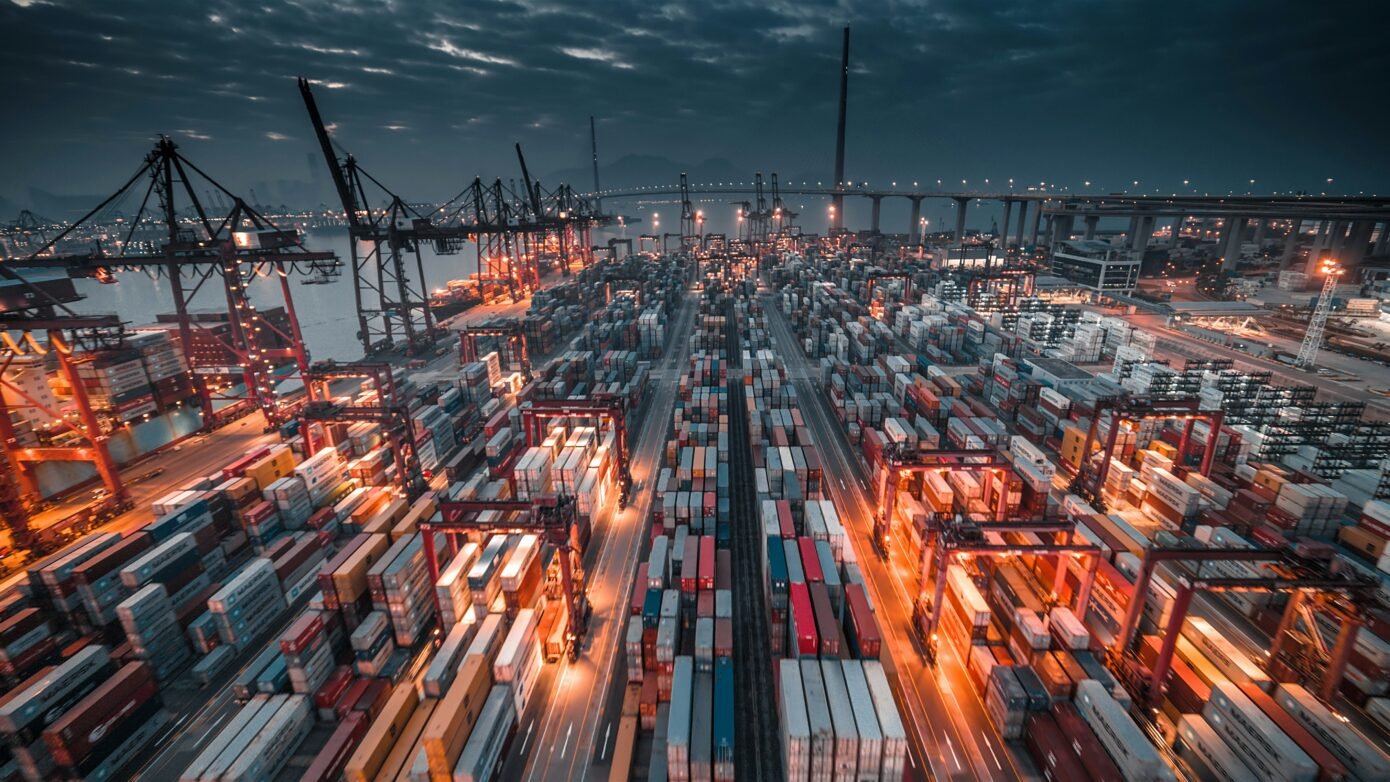
Strong supply chains are built to be proactive, not reactive
Global supply chains have never operated in a stable world. The organisations that understand this, and build accordingly, are the ones that maintain continuity, protect margin, and keep their customer commitments intact while others are scrambling for solutions. This article sets out what separates resilient supply chains from fragile ones, and the disciplined approach that makes the difference.
Businesses that stay in control are already one step ahead
Disruption is no longer a risk to plan for. It is a condition to operate within. Geopolitical tensions, regional conflicts, unstable energy prices, evolving trade restrictions, and shifting political landscapes are now permanent features of global commerce. These forces sit beyond the control of any individual business, yet their impact on the movement of materials, components, and finished goods is direct and immediate.
For organisations that depend on a steady flow of supply, the pressure can escalate quickly. Lead times extend, production schedules tighten, costs rise, and customer commitments come under strain.
The most resilient supply chains are not built for ideal conditions. They are engineered to perform through uncertainty, and that distinction is critical. What separates organisations that maintain continuity from those that struggle is rarely the speed of their response when disruption arrives. It is the quality of the decisions they made long before it did.Resilient organisations review their sourcing strategies, understand where risks exist within their supply networks, and put processes in place to maintain continuity when pressure builds.
Why many supply chains are more fragile than they appear
For the past two decades, global supply chain strategy has been shaped by three clear commercial objectives: reduce cost, improve efficiency, and maximise margin. Global sourcing has been central to achieving this. Access to lower production costs and specialised manufacturing capabilities around the world has allowed businesses to operate leaner, move faster, and compete more effectively. In stable conditions, this model delivers exactly what it promises. The challenge is what it can quietly create over time.
As sourcing strategies are refined and supplier networks consolidated, dependencies begin to build within the supply chain. Critical materials concentrated with a single supplier. Entire product lines reliant on components produced within one region. Logistics routes spanning multiple borders, ports, and transport networks before a single shipment reaches its destination. Each of these decisions carried commercial logic at the time they were made. Collectively, over time, they can introduce layers of structural risk that remain entirely invisible while operations run smoothly. It is only when disruption enters the system that the true extent of that exposure becomes clear.
The pandemic demonstrated this clearly. Factory shutdowns, labour shortages, and restrictions on movement across key manufacturing regions disrupted the supply of critical materials and components worldwide. In many industries, production did not slow because demand fell. It slowed because the materials required to manufacture products were no longer available.
A different but equally instructive disruption occurred in March 2021, when the Ever-Given container vessel ran aground and blocked the Suez Canal for six days. Hundreds of vessels were held in place, global shipping schedules collapsed, and one of the world’s most relied upon trade corridors became a bottleneck that reverberated across international supply chains for weeks.
More recently, escalating security threats in the Red Sea have compelled shipping operators to divert vessels away from the Suez route entirely, rerouting them around the Cape of Good Hope and adding significant time and cost to transit between Asia and Europe. A corridor that had long been treated as a reliable constant in global logistics became, almost overnight, a source of serious operational risk.
Each of these events carries the same lesson. Vulnerabilities within supply chains rarely announce themselves in advance. They remain embedded within the structure of the network, invisible during normal operations, until disruption forces them into the open.
The speed at which exposure can materialise is also worth noting. Governments can introduce sanctions that immediately restrict trade. Financial assets can be frozen. Entire regions can become commercially inaccessible as a result of political decisions that no individual business has the ability to influence or predict. For organisations with heavy concentration in a single source or region, the window between disruption and crisis can be very narrow.
This is why resilience cannot be approached as a contingency measure. It must be enclosed into the design of the supply chain itself, built in deliberately, reviewed regularly, and treated as a strategic priority rather than an operational afterthought.
Identifying hidden risks in your supply network
Many supply chain risks are not dramatic or obvious. In fact, they often sit quietly inside the structure of the supply network for years without drawing attention. While operations run smoothly these vulnerabilities remain hidden. Orders are fulfilled, materials arrive on time, and production continues as planned. The supply chain appears stable. The problem is that stability can create a false sense of security. Dependencies build over time and are often only discovered when disruption occurs.
This is not unlike personal health. Many problems develop quietly over time and only become visible when symptoms appear. Regular health checks help identify issues early before they become serious. Supply chains benefit from the same discipline. This is why organisations should periodically step back and challenge the structure of their supply network through scheduled process evaluation, effectively a Supply Chain Health Check.
Key questions worth asking include:
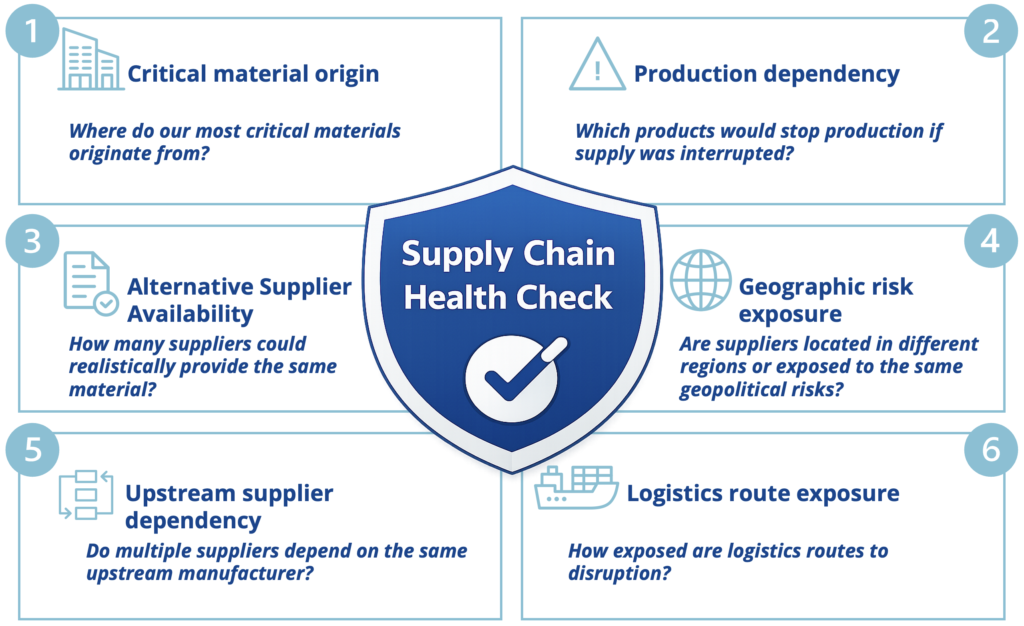
- Where do our most critical materials actually originate from
- Which products would stop production if supply was interrupted tomorrow
- How many suppliers could realistically provide the same material
- Are those suppliers located in different regions or exposed to the same geopolitical risks
- Do multiple suppliers depend on the same upstream manufacturer
- How exposed are our logistics routes to disruption or political change
Even when companies believe they have diversified their suppliers, the deeper supply network can tell a different story. Two suppliers may appear independent but still rely on the same upstream sources. Understanding where these hidden dependencies exist is the first step toward building a more resilient supply chain.
However, identifying risk is only part of the challenge. The real value comes from applying a structured approach to investigate those risks properly and uncover where vulnerabilities truly sit within the supply network. This is where a formal Supply Chain Health Check becomes valuable.
Understanding the root causes of supply chain vulnerability
When supply chains fail or experience disruption, the immediate cause is often easy to identify. A shipment is delayed, a supplier cannot deliver, a transport route becomes unavailable, or a political decision suddenly restricts trade. However, these events are usually symptoms rather than the real cause of the problem. In many cases the true vulnerability has been developing quietly within the supply chain for years.
Over time organisations optimise their operations for efficiency, cost reduction, and margin improvement. Global sourcing strategies are introduced, supplier networks are streamlined, and logistics routes are optimised to reduce cost and improve speed. Each of these decisions can make sense when viewed individually. However, when combined over time they can also create hidden dependencies that increase risk.
For example, companies may concentrate sourcing with a small number of suppliers in order to secure better pricing. Production may become dependent on materials originating from a single geographic region. Logistics networks may rely on a limited number of ports or transport corridors. None of these decisions are inherently wrong. In fact, they are often driven by sound commercial thinking.
The challenge is that when disruption occurs, these structural dependencies can quickly become points of failure. This is why organisations must periodically step back and examine not only where risks exist within the supply chain, but also why those risks developed in the first place.
Root cause thinking is essential when analysing supply chain vulnerability. By applying structured methods such as the 5 Whys, DMAIC, or Fishbone analysis, organisations can trace risks back through the supply network and uncover the decisions, dependencies, and constraints that allowed those vulnerabilities to develop. This deeper level of understanding allows businesses to move beyond reacting to disruption and instead design supply chains that are better prepared to withstand it.
Supply Chain Health Check Framework
Your objective should always be to build a Resilient Supply Chain. This requires using structured problem-solving methods to identify the root causes of issues, or in this case to uncover potential vulnerabilities within the supply chain that could impact capital, operations, or your customers. One commonly used method is the 5 Whys, a simple root cause analysis technique that helps trace problems back to their underlying source by repeatedly asking the question “Why?”.
When reviewing your supply chain structure, this approach can be applied to several key areas of risk. The diagram below illustrates a simple Supply Chain Health Check framework, where a series of critical questions help identify potential vulnerabilities that may threaten supply continuity.
__________________________________________
Below are some suggestions on the type of questions that should be asked and explored in depth, using techniques such as the 5 Whys to trace dependencies further upstream within the supply network.
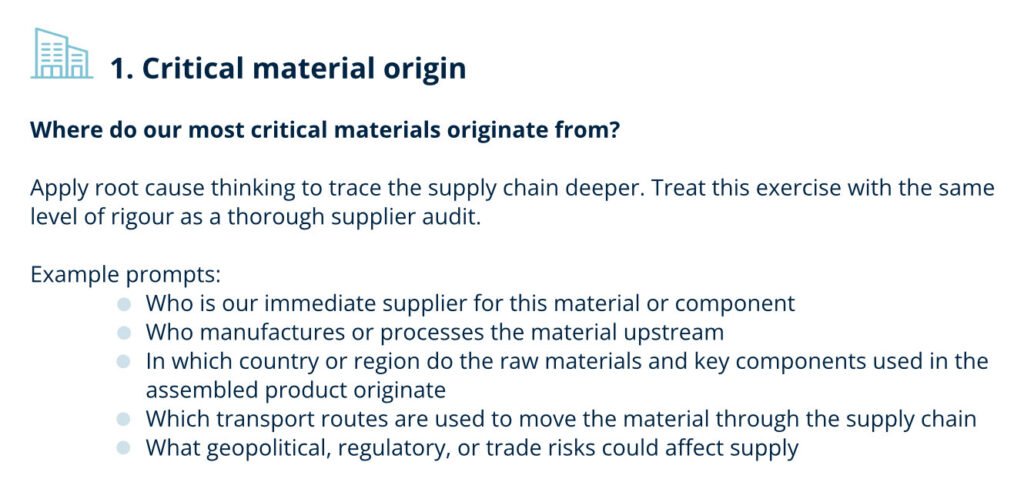
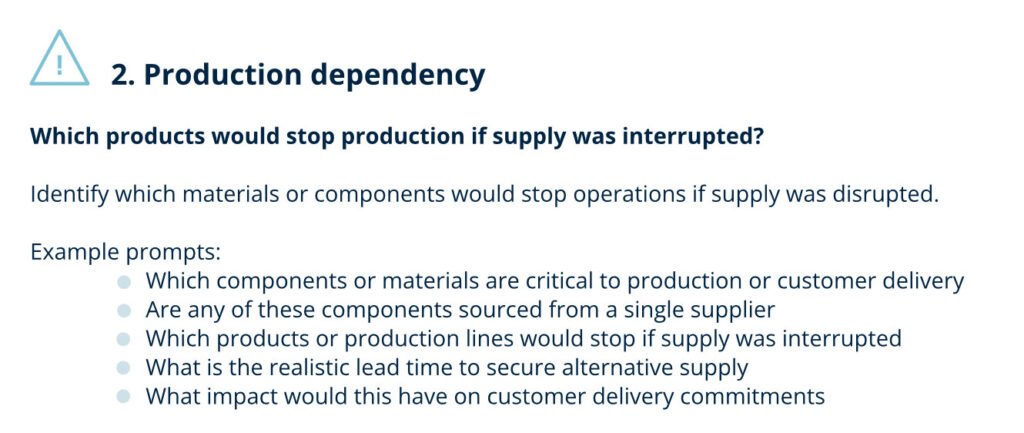
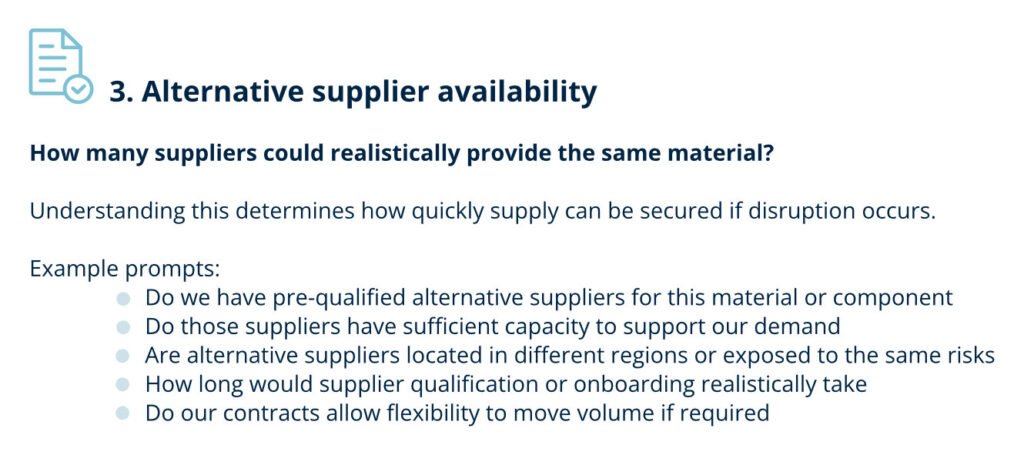
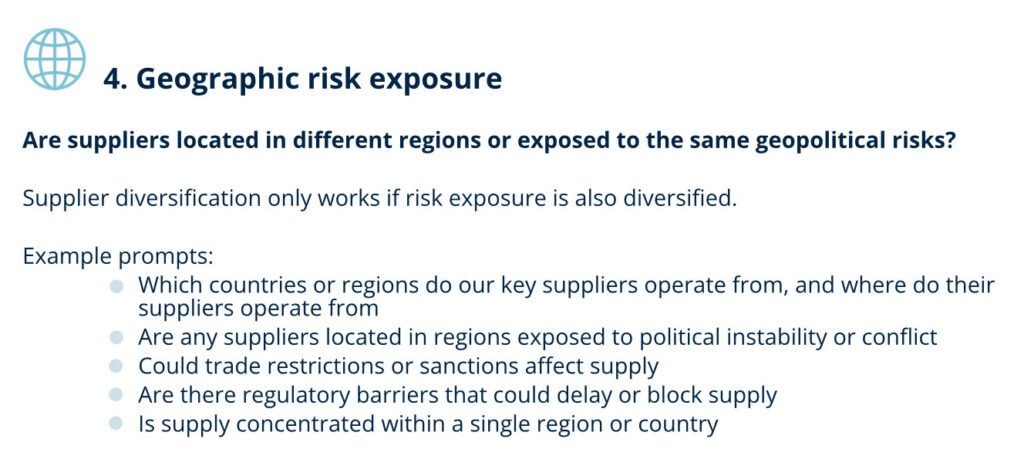
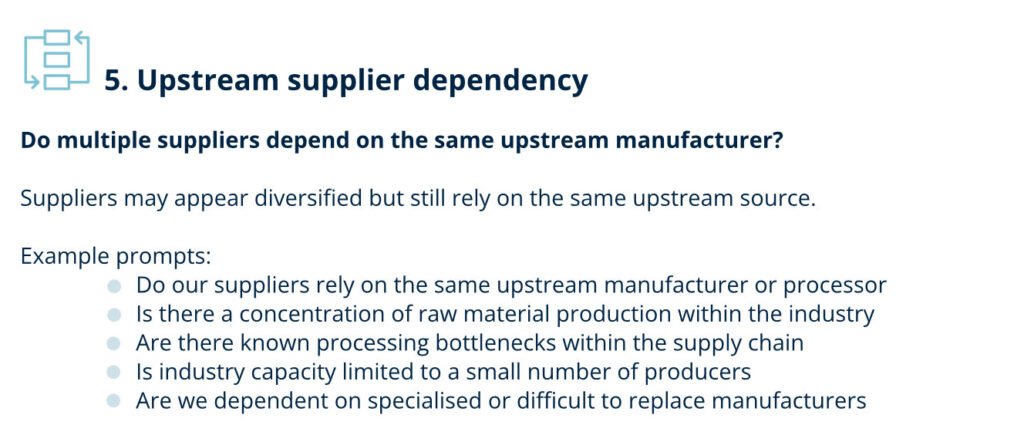
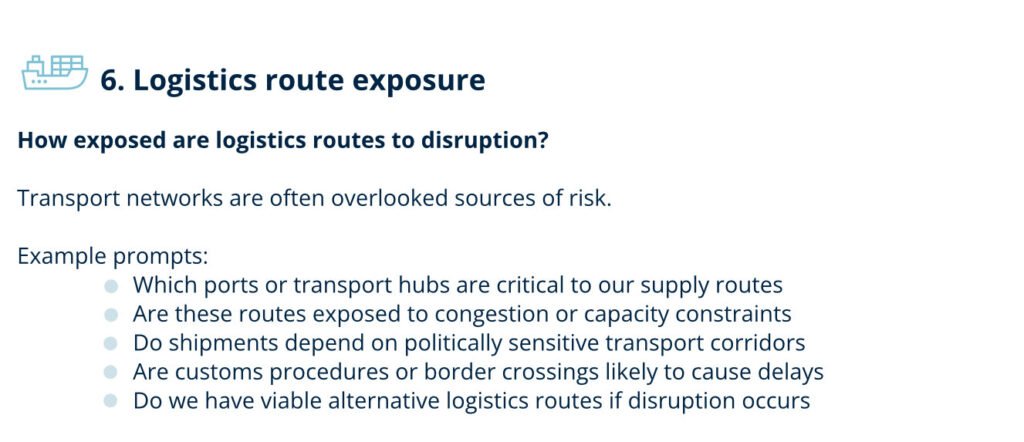
The questions are not limited to six. This framework is simply a starting point. The objective is to continuously challenge your supply chain structure, identify vulnerabilities early, and implement mitigation strategies before disruption occurs. Ultimately, the goal is to build a Resilient Supply Chain that you understand, monitor, and control.
Why reacting during disruption is already too late
One of the most common mistakes organisations make is waiting until disruption occurs before taking action. When a supplier fails, a transport route becomes unavailable, or geopolitical events suddenly restrict trade, companies often scramble to find alternative solutions. Unfortunately, by the time disruption has already started, the number of available options is usually limited.
Qualifying new suppliers takes time. Contracts must be negotiated. Materials may need to be tested or approved. Logistics routes must be arranged and validated. These activities cannot always be completed quickly, particularly when many organisations are competing for the same alternative sources of supply.
This is why resilience cannot be built during a crisis. It must be designed into the supply chain before disruption occurs. Organisations that perform regular supply chain reviews, understand their vulnerabilities, and identify alternatives in advance are far better positioned to respond when disruption inevitably appears. Preparation does not eliminate disruption, but it significantly reduces the impact.
Reviewing your sourcing strategy now
Supply chains rarely become vulnerable overnight. Most vulnerabilities develop gradually as organisations optimise their operations for efficiency, cost reduction, and margin improvement. Over time sourcing decisions may concentrate supply within a single region, rely heavily on one supplier, or depend on long and complex logistics routes. These decisions can make commercial sense individually, but when combined they can create hidden exposure to disruption.
Reviewing sourcing strategies on a regular basis helps organisations understand whether these risks have developed within their supply network. This review should not only examine supplier performance and cost competitiveness. It should also evaluate supplier concentration, geographic exposure, upstream dependencies, and the resilience of logistics routes used to move materials through the supply chain. The goal is not to eliminate global sourcing, but to ensure that sourcing decisions balance efficiency with resilience.
Building resilience with alternative suppliers and routes
Once vulnerabilities have been identified, organisations can begin to strengthen the resilience of their supply chain. One of the most effective ways to achieve this is by identifying and qualifying alternative suppliers before they are urgently required. Secondary sources of supply provide flexibility when disruption affects the primary supplier.
In some cases, this may involve qualifying additional suppliers in different regions. In others it may involve strengthening relationships with existing suppliers to better understand their own upstream dependencies. Resilience can also be improved by evaluating logistics routes. Materials that rely on a single port, transport corridor, or shipping route may be exposed to disruption that could be avoided through alternative routing options.
The objective is not to duplicate every element of the supply chain, but to ensure that critical materials and components are not dependent on a single fragile point of failure.
Turning risk awareness into a practical plan
Understanding risk is valuable, but awareness alone does not improve resilience. The real benefit comes from translating that understanding into practical actions that strengthen the supply chain over time. Organisations should develop mitigation plans that address the vulnerabilities identified during their supply chain health check. These plans may include qualifying alternative suppliers, diversifying sourcing regions, reviewing logistics routes, or improving visibility into upstream suppliers.
Regular review is also essential. Supply networks evolve continuously as suppliers change, markets shift, and geopolitical conditions develop. What appears resilient today may become vulnerable tomorrow. By embedding regular supply chain health checks into operational processes, organisations can maintain visibility over emerging risks and respond before disruption forces reactive decisions.
In an uncertain global environment, resilience is not achieved through chance. It is built through deliberate planning, continuous review, and informed decision making.
Final thought
Supply chains are no longer operating in predictable conditions. Disruption has become part of the environment organisations must operate within. When supply networks are designed purely for efficiency, hidden dependencies often build quietly over time. These vulnerabilities usually remain invisible until disruption forces them into the open.
Organisations that understand their supply networks, examine their sourcing strategies, and regularly review potential risks are far better positioned to maintain continuity when disruption occurs. Stop treating supply chain resilience as something to address during a crisis. Start building it into the design of your sourcing strategy, supplier network, and logistics routes.That is how organisations protect margin, maintain continuity, and stay in control when disruption appears.
When supply chains are reactive rather than proactive, disruption does not just create delays. It exposes hidden dependencies, weak contingency planning, and costly operational gaps.