


Supply chain performance is shaped by planning and design
Effective supply chains do not emerge through routine operations alone. They are shaped by the quality of the planning processes behind them and the design decisions that define how the network operates. When these foundations are clear and well structured, organisations gain control over inventory, service levels, and supplier performance. When they are weak or poorly coordinated, the supply chain gradually becomes reactive and unstable.
Planning and design are therefore not background activities. They are the disciplines that determine how well the entire system performs.
Many organisations underestimate their importance. Operational teams often spend large amounts of time reacting to problems such as rising inventory, unreliable service levels, or inconsistent supplier performance. In many cases these issues are not operational failures at all. They are the predictable outcome of planning decisions and structural design choices that were made earlier.
Understanding this relationship is essential for any organisation that wants to maintain stability across its supply chain.
Planning defines how demand and supply connect
At its core, supply chain planning exists to balance demand and supply. Forecasts provide an estimate of future demand, procurement decisions determine how supply enters the organisation, and inventory policies help manage the uncertainty that exists between the two.
When planning processes are disciplined and regularly reviewed, this balance becomes easier to maintain. Demand signals are interpreted realistically, purchasing behaviour remains aligned with actual requirements, and inventory levels reflect the needs of the business rather than the assumptions of individual departments.
When planning processes are weak or disconnected, the balance between demand and supply begins to drift. Forecasts may become overly optimistic, purchasing decisions may prioritise price over demand alignment, and operational teams may compensate for uncertainty by increasing inventory levels.
Over time the effects become visible across the organisation. Warehouses fill with products that are not moving at the expected rate, working capital becomes tied up in excess stock, and teams spend increasing amounts of time resolving problems that should never have developed.
Planning therefore determines far more than ordering patterns. It defines how effectively the supply chain interprets demand and responds to it.
How planning and design decisions shape supply chain performance
The relationship between planning decisions and operational performance is rarely visible at first glance. The effects appear gradually through inventory levels, service reliability, logistics stability, and supplier performance.
The diagram below illustrates how planning and design decisions influence the structure of the supply chain and ultimately determine operational outcomes.
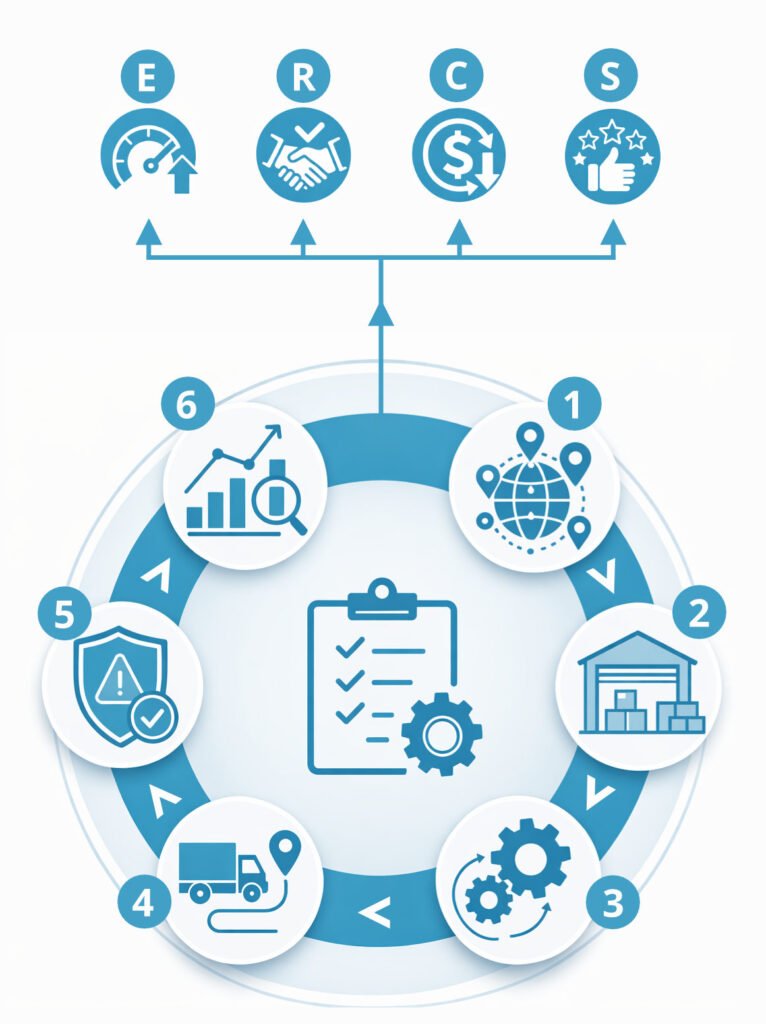
The six elements shown in the circular process represent the key areas where planning and design decisions shape how the supply chain operates.
1 – Network structure – The first design decision concerns the overall structure of the supply chain network. This includes supplier selection, manufacturing locations, distribution centres, and the geographic flow of products across the network.
Network structure determines how efficiently products can move through the system. When supplier locations, production sites, and distribution centres are aligned with customer demand, the network supports reliable service and stable logistics flows.
When network decisions are made purely on cost without considering lead time stability or supply risk, the supply chain becomes more exposed to disruption. Long supply routes, limited supplier alternatives, and extended lead times increase the likelihood of instability throughout the system.
2 – Inventory positioning – Once the network structure is defined, organisations must determine where inventory should be positioned across that network. Inventory may be held at suppliers, manufacturing locations, distribution centres, or closer to the customer.
These positioning decisions influence how quickly demand can be served and how much working capital becomes tied up in stock. When inventory is placed strategically, it supports service reliability while maintaining reasonable inventory exposure.
Poor positioning creates the opposite effect. Too much stock accumulates in the wrong locations, service performance becomes inconsistent, and operational teams struggle to maintain balance across the network.
3 – Process design – Operational processes determine how effectively the supply chain executes daily activities. Order processing, replenishment planning, production scheduling, and warehouse operations all form part of this process structure.
Well-designed processes create stability and predictability. Information flows clearly across departments, replenishment decisions follow consistent rules, and operational teams understand how the system should function.
When processes are unclear or poorly coordinated, operational noise increases. Teams compensate with manual intervention, urgent corrections, and reactive decision making.
4 – Logistics flow – Logistics connects suppliers, production facilities, warehouses, and customers. Transport planning, route structure, shipment consolidation, and delivery frequency all influence how smoothly products move through the network.
Effective logistics planning provides consistent product flow. Transport capacity is aligned with demand patterns and delivery schedules support operational stability.
When logistics flows are poorly planned, delays, expedited shipments, and rising transport costs become common responses to structural weaknesses in the system.
5 – Risk management – Supply chains operate in environments where uncertainty is unavoidable. Supplier disruptions, transport delays, demand volatility, and external events all introduce risk into the network.
Risk management decisions determine how well the supply chain can absorb these disruptions. Supplier diversification, safety stock policies, and contingency planning all contribute to maintaining operational stability.
Without risk planning, organisations often respond to uncertainty by increasing inventory levels or relying on emergency purchasing. These reactive responses frequently increase cost without improving long term stability.
6 – Demand understanding – The final element returns the process to its starting point. Effective supply chain planning begins with a realistic understanding of demand behaviour.
Demand signals guide procurement decisions, production volumes, and inventory policies. When demand is interpreted accurately, the supply chain can respond with confidence and maintain balance between supply and customer requirements.
Measuring supply chain performance through Efficiency (E), Reliability (R), Cost (C) and Service (S)
Design decisions within the supply chain ultimately reveal themselves through operational performance. The effects of planning choices are rarely visible immediately, but over time they become measurable through a small number of key indicators.
One practical way to evaluate supply chain performance is to monitor four core outcomes: efficiency, reliability, cost, and service. Together these form a simple but powerful framework for assessing whether planning and design decisions are producing the results the organisation expects.
Each of these areas can be measured through operational data that already exists within most supply chains.
Efficiency (E) – reflects how well the supply chain converts resources into operational output. It measures whether processes, assets, and inventory are being used productively.
Typical indicators include warehouse throughput, inventory turnover, order processing speed, and transport utilisation. When planning and design decisions are effective, these indicators improve naturally because the network is structured to support stable product flow.
When inefficiencies appear, the underlying cause often lies in earlier planning decisions. Poorly positioned inventory, fragmented processes, or unstable supply routes frequently create operational friction that reduces efficiency across the network.
Monitoring efficiency therefore provides an early indication of whether the supply chain design is supporting smooth operations.
Reliability (R) – measures the consistency with which the supply chain performs its core functions. Customers, suppliers, and internal operations all depend on predictable performance.
Common indicators include on time delivery, supplier lead time stability, order fulfilment accuracy, and production schedule adherence. When planning processes are disciplined and the network is well designed, these measures tend to remain stable.
When reliability declines, it often signals deeper structural issues. Unstable demand signals, long or variable supplier lead times, and poorly coordinated logistics flows can all introduce uncertainty into the system.
Tracking reliability allows organisations to detect instability early before it develops into larger operational disruptions.
Cost (C) – performance reflects how effectively the supply chain manages the financial impact of its decisions. Inventory holding costs, transport expenses, procurement costs, and operational overheads all contribute to the total cost of supply chain operations.
When planning decisions align closely with demand behaviour and network design supports efficient logistics, cost structures tend to remain controlled. Inventory levels stay aligned with actual demand and emergency interventions such as expedited shipments are minimised.
Rising costs often reveal hidden planning weaknesses. Excess inventory, fragmented transport planning, and reactive purchasing behaviour can quietly increase the financial burden of the supply chain.
Monitoring cost performance helps organisations understand whether planning decisions are delivering sustainable operational efficiency.
Service (S) – reflects how effectively the supply chain supports the needs of customers. Ultimately, the purpose of supply chain operations is to ensure products are available when and where they are required.
Typical indicators include order fill rates, customer delivery performance, product availability, and response times to changing demand.
Strong service performance normally emerges when planning, network design, and operational processes are aligned. Products are positioned appropriately across the network and supply remains responsive to customer demand.
When service levels decline, the cause is rarely isolated to a single operational issue. It usually reflects a broader misalignment between planning assumptions and real demand behaviour.Monitoring service performance therefore provides a clear indication of whether the supply chain is fulfilling its primary objective.
Using ERCS to guide improvement
When these four areas are monitored together, organisations gain a balanced view of supply chain performance. Efficiency, reliability, cost, and service are closely connected, and improvements in one area should not come at the expense of another.
The purpose of ERCS is not to create additional reporting, but to provide a structured way to interpret operational data. By analysing trends across these four areas, organisations can identify whether planning decisions and network design are strengthening the supply chain or gradually introducing instability.
In this way, ERCS becomes a practical framework for translating operational data into meaningful insight about how well the supply chain is performing.
Supply chain design shapes operational stability
While planning governs short term decisions, supply chain design determines how the network itself functions. Decisions about sourcing strategies, supplier locations, logistics routes, and inventory positioning influence how resilient and responsive the supply chain can be.
A well-designed supply chain provides flexibility and visibility. Suppliers are selected with consideration for reliability and lead time stability, logistics routes support consistent product flow, and inventory is positioned where it best supports demand. When disruption occurs, the organisation can respond without significant operational instability.
Poor design produces the opposite effect. Networks built purely around cost efficiency may perform adequately under normal conditions but struggle when conditions change. Long lead times, limited supplier alternatives, and poorly positioned inventory create delays and uncertainty throughout the system.
In these situations, operational teams are forced into reactive behaviour. Emergency purchasing, expedited shipments, and large inventory buffers become common responses to structural weaknesses in the network.
Design decisions therefore influence how stable the supply chain will remain over time.
Lifecycle thinking must influence planning decisions
Another important factor often overlooked in supply chain planning is product lifecycle behaviour. Products rarely maintain the same demand pattern throughout their existence. Demand grows during introduction and expansion, stabilises during maturity, and eventually declines as markets evolve.
Planning processes that ignore these lifecycle signals create inventory exposure. Procurement decisions may continue based on historical volumes even when demand has begun to slow. Forecast assumptions may remain unchanged while customer behaviour shifts. Over time the result is predictable. Inventory accumulates in products that no longer generate the level of demand originally expected.
Organisations that integrate lifecycle awareness into planning decisions manage inventory far more effectively. Purchasing volumes are adjusted as products mature, inventory exposure is reduced during decline phases, and the risk of excess, slow-moving, and forgotten inventory is significantly reduced.
Lifecycle awareness therefore becomes a practical tool for maintaining control over inventory across the supply chain.
Coordination across the organisation is essential
Supply chain planning cannot operate effectively in isolation. Demand planning, procurement, sales, operations, and finance all influence the decisions that shape inventory and supply behaviour.
When these functions operate independently, planning quickly becomes fragmented. Sales forecasts may change without visibility of supply constraints. Procurement decisions may prioritise purchasing efficiency without considering demand signals. Operational teams may be left managing inventory levels that no longer reflect actual market conditions.
Effective planning requires coordination and shared visibility across these functions. When information flows clearly and decisions are aligned, the supply chain becomes far more predictable. Demand changes are recognised earlier, supply decisions remain connected to real requirements, and inventory levels remain manageable.
Without this coordination, the supply chain becomes reactive by nature.
Final thought
Planning and design determine how well a supply chain performs long before products begin moving through the network. They influence how demand is interpreted, how supply enters the organisation, and how resilient the network will remain when conditions change.
When planning processes are disciplined and the supply chain is carefully designed, operations run with greater stability and control. Inventory supports demand, suppliers perform consistently, and operational teams can focus on improvement rather than firefighting.
When these foundations are weak, the supply chain becomes reactive. Inventory rises, operational noise increases, and organisations spend increasing effort managing the consequences of earlier decisions.
Strong supply chains are not built through reaction. They are built through deliberate planning and thoughtful design.